Pool Permits in Mississippi: A Homeowner's Guide
Key Takeaways
- Yes—an inground pool in Mississippi requires a building permit in essentially every city and county on the Gulf Coast, and permits are issued locally rather than by the state
- Most coastal projects involve more than one approval: a building permit, an electrical permit, a floodplain review if the lot is in a mapped flood zone, and HOA or POA architectural approval in planned communities
- Residential pool permit fees on the Mississippi Gulf Coast commonly run from roughly $100 to $600 depending on the jurisdiction and how fees are calculated, with plan review typically taking days to a few weeks
- Mississippi and local codes require a safety barrier around a residential pool—generally a fence at least 48 inches high with self-closing, self-latching gates—and final inspection usually depends on it
Do You Need a Permit for a Pool in Mississippi?
Yes. An inground swimming pool is a permanent structure with electrical and plumbing components, so it requires a building permit in effectively every municipality and county on the Mississippi Gulf Coast. Permits are issued by your city or county building department, not by the state, and requirements differ from one jurisdiction to the next.
That last point is the one that surprises homeowners most. There is no single statewide pool permit in Mississippi. A homeowner in Bay St. Louis applies to the City of Bay St. Louis; someone on an unincorporated Hancock County lot applies to the county; a Gulfport or Long Beach resident applies to their own city. Fee schedules, submittal requirements, inspection sequences, and even setback distances vary between offices that are fifteen minutes apart.
What is consistent is the framework. Mississippi jurisdictions that enforce building codes work from editions of the International Residential Code and related model codes, and residential pool electrical work falls under the National Electrical Code. Public and semi-public pools—at hotels, apartment complexes, and subdivisions with shared amenities—are separately regulated by the Mississippi State Department of Health. A backyard pool at a single-family home is not a public pool and does not fall under those health department rules, which is a common point of confusion.
A note on scope: above-ground and storable pools are treated differently by many jurisdictions, and some exempt very small or temporary pools from permitting while still requiring a barrier. If you are considering anything other than an inground pool, confirm with your local office rather than assuming.
Which Approvals a Gulf Coast Pool Project Involves
Most pool projects on the Mississippi Gulf Coast involve three to five separate approvals rather than one. The building permit is the anchor, but floodplain review, electrical permitting, and private architectural approval are common additions—and each has its own timeline.
Here is what typically applies to a residential inground pool in Hancock or Harrison County:
- Building permit. The primary approval. Submittals generally include a site plan or plot plan showing the pool location, dimensions, setbacks from property lines, decking, equipment placement, and the planned safety barrier.
- Electrical permit. Pool equipment requires dedicated circuits and code-required bonding, and that work is permitted and inspected—sometimes under the building permit, sometimes separately. It must be performed by a licensed electrician.
- Floodplain development permit. Much of the coast sits in mapped FEMA flood zones. If your lot does, the local floodplain administrator reviews the project, and elevation or equipment-placement conditions may apply.
- Zoning or setback verification. Cities enforce minimum distances between a pool, the water's edge, equipment pads, and property lines, along with limits on how much of a lot can be covered by impervious surface.
- HOA or POA architectural review. In planned communities this is a private approval that runs parallel to the public one. Diamondhead is the clearest local example—our local guide to fiberglass pools in Diamondhead, MS covers how POA review interacts with city permitting there.
- Utility locates. Before any digging, Mississippi law requires notification to the state's 811 one-call center so underground utilities can be marked. This is free and is not a permit, but skipping it carries liability.
A separate permit may also be needed for structures you add around the pool—a pergola, screen enclosure, outdoor kitchen, or pool house. Coastal Hancock and Harrison counties carry some of the highest design wind speeds in Mississippi, so attached and freestanding structures near the pool face wind-load requirements that an inland project would not.
Pool Fence and Safety Barrier Requirements
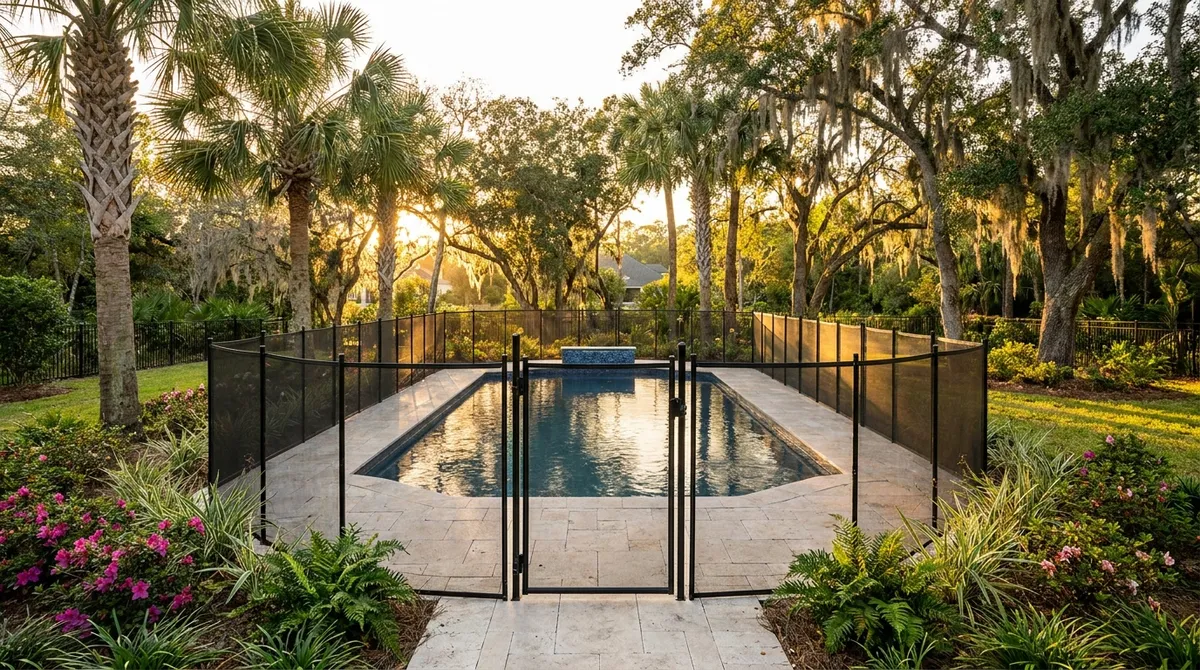
Mississippi jurisdictions require a safety barrier enclosing a residential pool, and it is typically the item that determines whether your project passes final inspection. The widely applied standard calls for a barrier at least 48 inches high, with no gaps that allow a 4-inch sphere to pass, and gates that are self-closing and self-latching.
Common requirements you should expect your local building department to enforce:
- Minimum height of 48 inches measured on the side facing away from the pool
- Gates that swing away from the pool, self-close, and self-latch, with the release mechanism positioned high on the gate
- No climbable features on the outside of the barrier, and limits on horizontal members that could act as a ladder
- Door and window alarms or a powered safety cover where a wall of the house serves as part of the barrier
Because exact figures and allowances vary by adopted code edition and local amendment, verify current requirements with your building department before ordering fencing. Fencing is also one of the items most frequently left out of pool bids, which is worth checking line by line when you compare pool builder quotes in Mississippi.
Code compliance is a floor, not a complete safety plan. Layered protection—barriers, alarms, covers, supervision rules, and swim skills—is what actually reduces risk, and our complete guide to residential swimming pool safety walks through each layer. Your insurer may also have its own barrier conditions that go beyond code; see our guide to how home insurance covers pools in Mississippi.
What Pool Permits Cost and How Long They Take
Residential pool permit fees on the Mississippi Gulf Coast commonly fall between roughly $100 and $600, though the method matters more than the range: many jurisdictions calculate the fee from declared project valuation, so a larger project costs more to permit. Plan review often takes a few days to a few weeks.
Budget for these variables:
- Fee basis. Flat-fee jurisdictions are predictable. Valuation-based schedules scale with the cost of the work, and some offices add separate electrical, plan review, or zoning fees.
- Floodplain review. Adds a review step, sometimes a modest fee, and occasionally a request for an elevation certificate or surveyed site plan.
- HOA or POA review. Private architectural committees may charge application or review fees and often meet on a set schedule, which can add weeks independent of city timelines.
- Resubmittals. An incomplete site plan is the usual cause of delay. One clean submittal is faster than three rushed ones.
For planning purposes, treat permitting as a phase that runs in the weeks before work begins rather than a same-day formality—especially in spring, when pool and remodeling applications peak across the coast. If you are working through budget as well as approvals, our breakdown of what drives fiberglass pool prices on the Gulf Coast covers the cost side in detail.
Who Pulls the Permit—You or Your Pool Builder?
In most residential pool projects the contractor applies for the permit, because the permit holder carries responsibility for code compliance on the permitted work. Some jurisdictions allow a homeowner to pull an owner-builder permit, but doing so shifts that responsibility—and often the liability—to you.
This is worth a direct conversation before you sign anything. Ask each builder you are considering:
- Who submits the application, and in whose name is the permit issued?
- Who schedules and attends inspections?
- Are permit and inspection fees included in the quoted price, or billed separately?
- What happens to the schedule if plan review requires a resubmittal?
- How many pools have you permitted in this specific city or county in the past two years?
The last question matters more than it sounds. A builder who works in Waveland, Bay St. Louis, Pass Christian, and Gulfport every month knows each office's submittal preferences and inspection rhythm. And if a contractor ever suggests skipping a permit or having you pull it "to save time," treat that as a significant warning sign—unpermitted work can surface years later during an appraisal, an insurance claim, or a home sale.
Bay Pool Company is based in Waveland and builds fiberglass pools across Hancock and Harrison counties, so permitting in these jurisdictions is routine work rather than a first attempt. Ready to talk through what your lot and your city will require? Contact Bay Pool Company for a free quote, call 228.819.7219, or browse shell sizes and options on our pools and spas page.
Frequently Asked Questions
What permits do I need for a pool in Mississippi?
An inground pool in Mississippi generally requires a building permit from your city or county, plus an electrical permit for pool equipment circuits and bonding. Lots in mapped FEMA flood zones also need floodplain review, and planned communities require private HOA or POA architectural approval. Requirements are set locally, so confirm the current list with your building department.
How much does a pool permit cost on the Mississippi Gulf Coast?
Residential pool permit fees on the Gulf Coast commonly run from roughly $100 to $600. Many jurisdictions calculate the fee from declared project valuation rather than charging a flat rate, and separate electrical, plan review, or zoning fees may apply. HOA or POA architectural review can carry its own application fee in communities like Diamondhead.
Does Mississippi require a fence around a swimming pool?
Mississippi jurisdictions require a safety barrier around a residential pool. The widely applied standard is a barrier at least 48 inches high with no gap allowing a 4-inch sphere to pass, and gates that swing away from the pool, self-close, and self-latch. Exact requirements depend on the code edition your city or county has adopted, so verify locally.
Can I pull my own pool permit as a homeowner?
Some Mississippi jurisdictions allow an owner-builder permit for work on your own residence, but the permit holder is responsible for code compliance on the permitted work. In most residential pool projects the contractor applies instead. Ask your builder in writing who applies, whose name the permit is issued in, and whether fees are included in the quote.
What happens if a pool was built without a permit?
Unpermitted work typically surfaces later—during an appraisal, a home sale, or an insurance claim. Jurisdictions may require a retroactive permit, inspection of concealed work, corrections, or fines, and buyers and insurers often ask for documentation. If you are buying a Gulf Coast home with an existing pool, ask for the permit records and final inspection approval.
This article is general educational information about pool ownership. It does not describe the methods, specifications, or warranties of Bay Pool Company. Construction and installation practices vary by site and follow the pool manufacturer's specifications.