Does Home Insurance Cover Your Pool in Mississippi?
Key Takeaways
- A swimming pool in Mississippi is usually covered as a "detached" or "other" structure under your standard homeowners policy, but coverage limits, liability, and storm damage all need to be reviewed before and after installation
- Liability is the single most important pool insurance Mississippi consideration—many insurers require a minimum of $300,000 to $500,000 in personal liability coverage, and some recommend an umbrella policy of $1 million or more for pool owners
- Wind and hurricane damage to a fiberglass pool's equipment and decking is generally covered by homeowners insurance, but flood-related damage and storm surge require separate flood coverage on the Gulf Coast
- Code-compliant fencing, gates, and safety features are not just legal requirements in Mississippi—they directly affect whether your insurer will write or renew a pool policy
Does Homeowners Insurance Cover a Pool in Mississippi?
Yes, most standard homeowners insurance policies in Mississippi cover an in-ground swimming pool, typically as a detached or "other structure" on your property. That coverage usually includes the pool shell, decking, and attached equipment against covered perils like fire, wind, and theft—but liability and flood damage are handled separately and deserve close attention.
The important detail is that a pool changes your risk profile, so it changes your policy. When you add a fiberglass pool in Bay St. Louis, Gulfport, or Diamondhead, you are adding both a valuable structure and a potential liability exposure. Both need to be reflected in your coverage limits, and failing to update your policy can leave you underinsured exactly when a claim arises.
Getting pool insurance Mississippi homeowners can rely on starts before the shell is in the ground. Call your insurance agent and confirm three things: that your "other structures" limit is high enough to rebuild the pool, that your personal liability limit is adequate, and whether your carrier has specific safety requirements—such as fencing or a removed diving board—as a condition of coverage. Handling this conversation early prevents surprises after the pool is in the ground.
Liability Coverage: Your Biggest Pool Insurance Concern
Liability is the most important part of pool insurance in Mississippi, because a swimming pool is legally considered an "attractive nuisance"—something that can draw children onto your property and create owner responsibility for injuries. Most insurers want pool owners to carry at least $300,000 to $500,000 in personal liability coverage.
A standard homeowners policy includes personal liability protection, which covers injuries that happen on your property, including in or around the pool. The default limit on many policies, however, is only $100,000—often too low for a pool owner. If a guest is injured and medical or legal costs exceed your limit, you are personally responsible for the difference.
Two steps protect you here:
- Raise your liability limit. Increasing personal liability from $100,000 to $500,000 is usually inexpensive—often a small annual increase—and it meaningfully reduces your exposure.
- Consider an umbrella policy. An umbrella policy adds $1 million or more in liability coverage above your homeowners limits, typically for a few hundred dollars a year. For pool owners who entertain frequently, this is one of the most cost-effective protections available.
Reducing the underlying risk matters just as much as the coverage. Proper fencing, self-latching gates, pool covers, and clear safety rules lower the chance of an incident in the first place. Our complete guide to residential swimming pool safety walks through the barriers and habits that protect both your family and your liability standing.
Storm, Flood, and Hurricane Damage on the Gulf Coast
On the Mississippi Gulf Coast, your homeowners policy generally covers wind and hurricane damage to a pool's equipment, decking, and screens—but flooding and storm surge are excluded and require a separate flood policy. This distinction is critical in Hancock and Harrison counties, where named storms are a routine part of pool ownership.
Here is how the two perils typically break down for a Gulf Coast pool:
Wind and hurricane (usually covered). Damage from high winds—a torn pool enclosure, dislodged equipment, debris impact, or destroyed decking—generally falls under your homeowners policy, though many Mississippi coastal policies carry a separate, higher hurricane or named-storm deductible. Know that number before a storm season begins.
Flood and storm surge (separate policy required). Rising water, storm surge, and flood damage are excluded from standard homeowners insurance everywhere in the country. On the coast, where many properties sit in FEMA flood zones, a National Flood Insurance Program (NFIP) or private flood policy is essential. Flooding can lift an improperly anchored pool shell or undermine decking.
One advantage of fiberglass for the Gulf Coast is resilience. A properly anchored fiberglass shell, installed by a builder who understands local flood zones and water tables, holds up well in storm conditions. That installation quality is also what protects your insurability. For season-specific preparation, see our hurricane preparedness guide for fiberglass pools in Mississippi, which covers how to secure equipment and protect the shell before a storm makes landfall.
How a Pool Affects Your Insurance Premium in Mississippi
Adding a pool typically raises a Mississippi homeowner's annual premium modestly—often in the range of $50 to $100 per year for the added structure value, plus more if you increase liability limits or add an umbrella policy. The exact figure depends on your coverage choices, your carrier, and the safety features you install, but pool insurance Mississippi owners pay is generally a small share of the overall cost of pool ownership.
Several factors influence the premium impact:
- Added structure value. Insuring the pool itself as an "other structure" adds replacement cost to your policy, which raises the premium in proportion to the pool's value.
- Liability limits. Higher liability limits and an umbrella policy add cost, but this is the spending that actually protects your finances.
- Safety features. Fencing, covers, alarms, and the absence of a diving board can lower your risk classification, and some insurers offer modest credits for them.
- Pool type and condition. A new, well-maintained fiberglass pool from a reputable installer presents lower risk than an aging concrete pool with cracking or outdated equipment.
It is worth weighing the modest premium increase against what a pool adds to your property. A quality fiberglass pool generally increases home value and appeal on the Gulf Coast—a tradeoff we examine in our guide on how fiberglass pools boost home value in Mississippi. For most homeowners, the insurance cost is a small line item next to the lifestyle and resale benefits.
Planning a pool and want a clear, itemized picture of the project before you call your agent? Contact Bay Pool Company for a free quote or call us at 228.819.7219, and explore shapes and features on our pools and spas page.
Fencing, Safety, and Keeping Your Coverage Valid
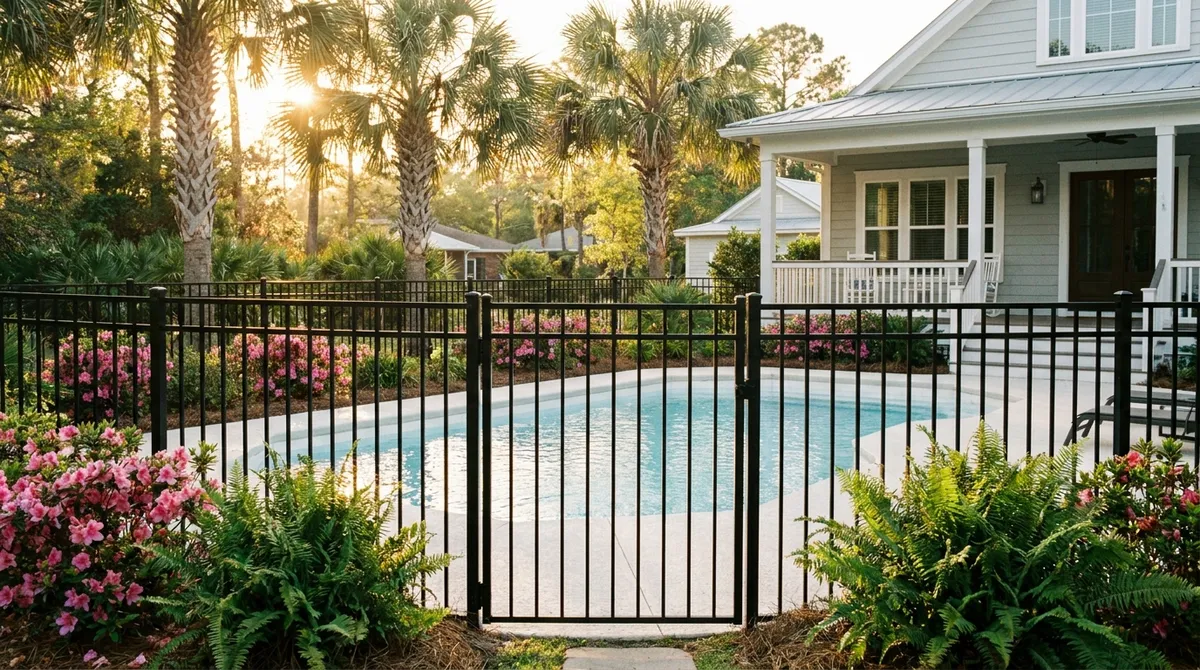
In Mississippi, code-compliant fencing and safety barriers are both a legal requirement and a condition many insurers attach to pool coverage. A pool that lacks a proper barrier can result in a denied claim, a non-renewed policy, or a refusal to write coverage at all—so safety compliance directly protects your insurance.
Most Gulf Coast jurisdictions, following the International Residential Code, require a barrier at least 48 inches high around a residential pool, with self-closing and self-latching gates that open outward, away from the pool. Latches must sit high enough that small children cannot reach them. These requirements are typically verified during the permitting and inspection process, which is one more reason to work with a builder who pulls every permit correctly.
Beyond the fence, insurers and safety experts favor layered protection: a self-latching gate, a safety cover, door and gate alarms, and—critically—no unsupervised access for children. Many carriers will decline to insure a pool with a diving board or slide because of the elevated injury risk, so confirm your insurer's stance before adding either feature.
Keeping coverage valid is ultimately about documentation and upkeep. Photograph your completed pool, fencing, and equipment for your records, keep your installation and warranty paperwork, and tell your agent about any major changes. A properly built, properly fenced, well-documented pool is one an insurer is glad to cover—and one that protects your family and your finances through every Gulf Coast season.
Frequently Asked Questions
Does homeowners insurance cover swimming pools in Mississippi?
Yes. Most standard Mississippi homeowners policies cover an in-ground pool as a detached or "other structure," including the shell, decking, and attached equipment against covered perils like wind, fire, and theft. Liability for injuries and flood or storm-surge damage are handled separately, so pool owners should review their liability limits and add flood coverage if they are in a Gulf Coast flood zone.
How much does a pool raise my insurance premium in Mississippi?
Adding a pool typically raises a Mississippi homeowner's annual premium modestly—often $50 to $100 per year for the added structure value—plus more if you raise liability limits or add an umbrella policy. Safety features like fencing, covers, and no diving board can lower your risk classification. The exact increase depends on your carrier, coverage choices, and the pool's value and condition.
Does homeowners insurance cover hurricane damage to a pool on the Gulf Coast?
Wind and hurricane damage to a pool's equipment, decking, and enclosures is generally covered by Mississippi homeowners insurance, though coastal policies often carry a separate named-storm deductible. Flood and storm-surge damage are excluded and require a separate flood policy through the NFIP or a private insurer—essential coverage for the many Gulf Coast properties in FEMA flood zones.
How much liability coverage do I need as a pool owner?
Most insurers want pool owners to carry at least $300,000 to $500,000 in personal liability coverage, because a pool is legally an "attractive nuisance." Many owners add an umbrella policy of $1 million or more for a few hundred dollars a year. Raising the default $100,000 liability limit is inexpensive and is one of the most important steps a pool owner can take.
Do I need a fence around my pool to keep my insurance valid?
Generally yes. Mississippi jurisdictions require a barrier at least 48 inches high with self-closing, self-latching gates, and many insurers make code-compliant fencing a condition of coverage. A pool without a proper barrier can lead to a denied claim or a non-renewed policy. Verify your barrier passes local inspection and confirm your insurer's specific safety requirements before the pool is in use.