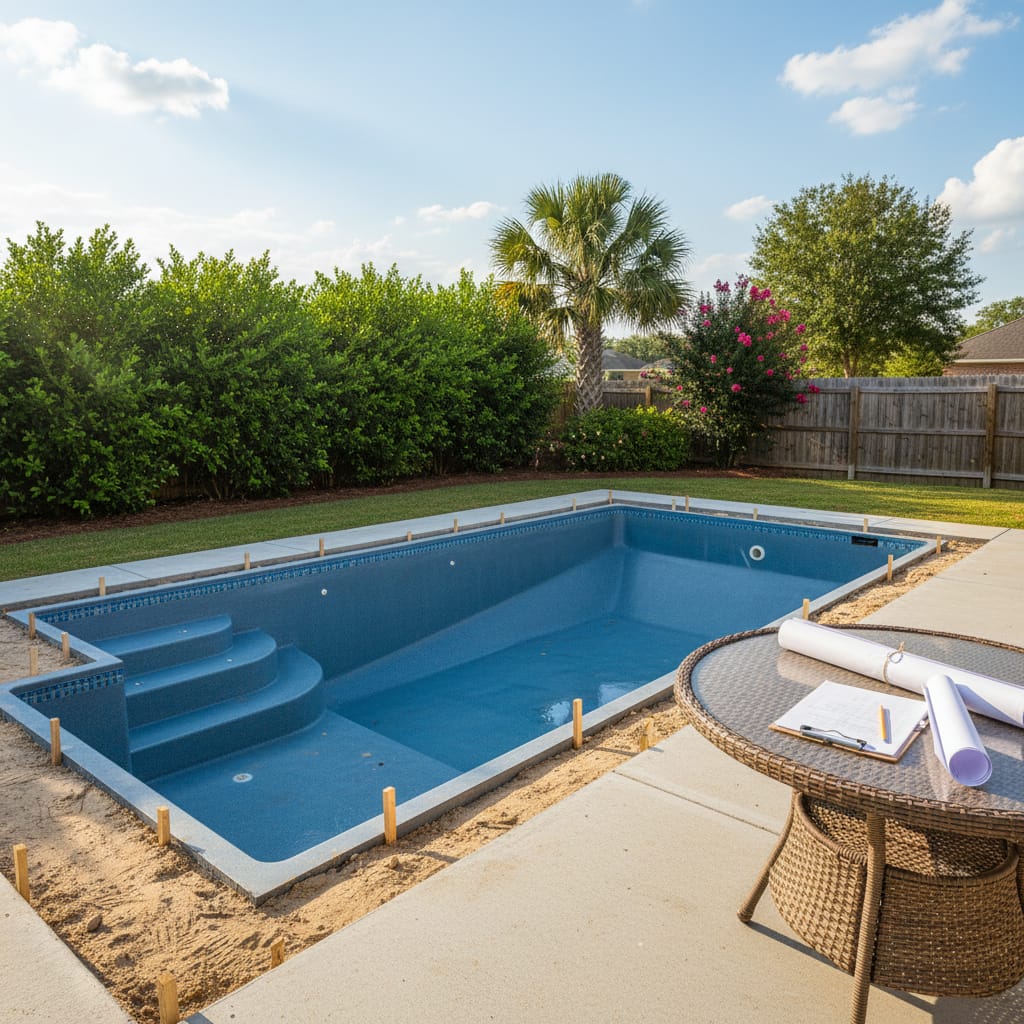
Pool Permits for Fiberglass Pool Installation in Mississippi
Key Takeaways
- Mississippi requires a building permit for all in-ground swimming pool installations, including fiberglass pools
- Hancock County and Harrison County each have specific setback, fencing, and electrical inspection requirements
- Pool barrier fencing must be at least 48 inches tall with self-closing, self-latching gates per the International Residential Code
- A licensed, insured pool contractor like Bay Pool Company handles most permit paperwork on your behalf
Do You Need a Permit for a Pool in Mississippi?
Yes. Every in-ground fiberglass pool installation in Mississippi requires a building permit from your local county or municipality before construction begins. This is not optional—installing a pool without a permit can result in fines, forced removal, or complications when you sell your home.
Mississippi does not have a single statewide pool permitting office. Instead, permits are handled at the county or city level. On the Mississippi Gulf Coast, that means working with either Hancock County (covering Bay St. Louis, Waveland, and Diamondhead) or Harrison County (covering Gulfport, Biloxi, Long Beach, and Pass Christian) building departments, depending on your property's location.
The permit process ensures your pool meets structural, electrical, and safety standards. Inspectors verify that the excavation, plumbing, electrical work, and safety barriers all comply with adopted building codes before your pool is approved for use.
If you're working with an experienced pool builder, the permitting process is straightforward. Most reputable contractors submit permit applications on behalf of homeowners and coordinate all required inspections. For a closer look at what the full build process involves, see our guide on the process of installing Mississippi fiberglass pools.
What Permits and Inspections Are Required?
A typical fiberglass pool installation on the Gulf Coast involves multiple permits and inspections. The exact requirements vary by jurisdiction, but here is what most homeowners can expect.
Building permit. This is the primary permit covering the pool shell installation, excavation, backfill, and decking. Your contractor submits a site plan showing the pool's location on your property, dimensions, and distance from property lines, structures, and utilities.
Electrical permit. Pool equipment—pumps, lights, heaters, and salt systems—requires dedicated electrical circuits. A licensed electrician pulls this permit and ensures all wiring meets the National Electrical Code (NEC) requirements for swimming pools, including proper bonding and grounding of all metal components within five feet of the pool.
Plumbing permit. Some jurisdictions require a separate plumbing permit for pool water supply and drainage connections. This covers the circulation system, backwash lines, and any connections to the municipal water supply.
Inspections during construction. Most counties require at least two to three inspections: one after excavation and before backfill, one for electrical bonding and equipment, and a final inspection after the pool, decking, and fencing are complete. Each inspection must pass before work continues to the next phase.
Zoning verification. Before issuing a building permit, the building department confirms that your property's zoning classification allows swimming pools and that your proposed pool location meets all setback requirements.
Pool Fencing and Safety Barrier Requirements
Mississippi adopts the International Residential Code (IRC), which includes specific requirements for residential swimming pool barriers. These rules exist to prevent unsupervised access by young children and are strictly enforced during final inspections.
Minimum fence height is 48 inches, measured on the outside of the barrier. The fence must completely enclose the pool area with no gaps or openings large enough for a four-inch sphere to pass through.
Gates must be self-closing and self-latching, with the latch positioned at least 54 inches above the ground on the pool side, or equipped with a lock or key-operated mechanism. Gates must swing outward, away from the pool.
The house wall can serve as one side of the barrier if all doors leading to the pool area have self-closing devices and audible alarms. Sliding glass doors require additional alarm systems or locks that meet code specifications.
For families with children, pool safety extends well beyond fencing. Our complete guide to residential swimming pool safety covers layers of protection including alarms, covers, and supervision best practices.
Setback and Zoning Requirements on the Gulf Coast
Setback rules determine how far your pool must be from property lines, structures, septic systems, and utility easements. These vary by municipality across the Mississippi Gulf Coast.
Hancock County (Bay St. Louis, Waveland, Diamondhead) typically requires a minimum of 10 feet from rear and side property lines for in-ground pools. Pools cannot be located within utility easements, and additional setbacks may apply near septic systems—usually 10 to 15 feet from the drain field.
Harrison County (Gulfport, Biloxi, Long Beach, Pass Christian) enforces similar setback distances, though specific requirements can vary between incorporated cities and unincorporated areas. Always verify with your local building department before finalizing your pool placement.
Flood zone considerations. Many properties along the Mississippi Gulf Coast fall within FEMA flood zones. Pool installations in flood zones may require additional engineering documentation, elevated equipment pads, or anchoring specifications to prevent the fiberglass shell from floating during high water events. Your contractor should assess flood zone status early in the planning process.
HOA restrictions. If your property is in a homeowners association—common in Diamondhead and newer developments in Long Beach—additional architectural review may be required before you can obtain a building permit. HOA approval timelines vary from two weeks to two months.
The Permit Application Process Step by Step
Understanding the timeline helps you plan your fiberglass pool installation without surprises.
Step 1: Site plan preparation (1–2 days). Your pool contractor prepares a scaled site plan showing property boundaries, the proposed pool location, equipment placement, fencing, and distances from structures and property lines.
Step 2: Permit submission (1 day). The contractor submits the application, site plan, and any required engineering documents to the county or city building department along with the permit fee. Residential pool permit fees on the Gulf Coast typically range from $150 to $500.
Step 3: Plan review (5–15 business days). The building department reviews your submission for code compliance. Straightforward projects may be approved in under a week; complex sites or flood zone properties take longer.
Step 4: Permit issuance. Once approved, the permit is posted at the job site and construction begins. Your contractor schedules inspections at each required phase.
Step 5: Final inspection and approval. After the pool, decking, equipment, and fencing are complete, a final inspection verifies everything meets code. Passing this inspection means your pool is officially approved for use.
Working with an experienced Gulf Coast pool builder simplifies this entire process. Bay Pool Company coordinates permits, inspections, and all construction phases for homeowners across South Mississippi. For tips on selecting the right contractor, read our guide on choosing the best fiberglass pool contractor in Gulfport, MS.
Frequently Asked Questions
How much does a pool permit cost in Mississippi?
Residential pool permit fees on the Mississippi Gulf Coast range from $150 to $500, depending on the jurisdiction and scope of work. Electrical permits typically add $75 to $150. Your contractor includes these costs in the overall project estimate, so there are usually no surprise fees at the permitting stage.
How long does it take to get a pool permit approved?
Plan review typically takes 5 to 15 business days in Hancock and Harrison Counties. Simple residential fiberglass pool installations on standard lots are often approved within one week. Properties in flood zones or with HOA requirements may take three to four weeks for all approvals.
Can I install a fiberglass pool without a permit?
No. Installing a pool without a permit violates Mississippi building codes and can result in fines, a stop-work order, or mandatory removal. Unpermitted pools also create problems during home sales, as title companies and buyers require proof of permitted construction. Always obtain proper permits before breaking ground.
Do I need a fence around my pool in Mississippi?
Yes. Mississippi adopts the International Residential Code, which requires a barrier at least 48 inches tall completely enclosing the pool area. The barrier must have self-closing, self-latching gates. Failure to install a compliant barrier will result in a failed final inspection, and your pool will not be approved for use until the fencing meets code.
Does my homeowners insurance cover a new pool?
Most homeowners insurance policies in Mississippi can be extended to cover a swimming pool, but it is not automatic. Contact your insurance provider before installation to add the pool as a scheduled structure. Expect a modest premium increase of $50 to $100 annually. Liability coverage is especially important—most insurers require the code-compliant fencing described above as a condition of coverage.