
Energy Efficient Pool Equipment: Cut Your Pool Power Use (and Costs) in 2026
Quick Answer: How to Make Your Pool More Energy Efficient in 2026
The fastest way to cut pool energy use is to upgrade to an ENERGY STAR certified variable speed pool pump, optimize your run times based on actual filtration needs, use a high-efficiency heater or heat pump where heating is required, and add a quality pool cover that stays on when you're not swimming.
Here's the short version of what to do:
Replace any single speed pump over 1 HP installed before 2015 with a variable speed model in the 1.0–2.7 THP range
Program your pump to run 8–12 hours daily at low RPM instead of 6 hours at full speed
Add a solar cover and aim for at least 8 hours of coverage per day during swim season
If you heat your pool, consider an electric heat pump (COP 4–6) over gas in mild climates
Check your utility's rebate programs—many offer $200–$400 back on qualifying pumps
Schedule most pump operation during off-peak electricity hours if your utility offers time-of-use rates
Realistic savings for 2026: upgrading from an old single speed pump to a modern variable speed pumps can cut circulation electricity by 70–80%, translating to $600–$1,400 per year in total utility savings on typical U.S. residential pools, depending on local rates and usage patterns.
One important note: variable speed pumps became the federal standard for most new in-ground pool installations in 2021 under DOE rules. But millions of existing pools still run older, inefficient pumps—which means there's a massive opportunity for pool owners who haven't upgraded yet.
Why Pool Equipment Efficiency Matters
Your swimming pool isn't just a place to cool off in summer—it's also one of the largest energy users in your home. In warm states like California, Texas, Florida, and Arizona, pool systems (pump, heater, lights, and accessories) often rank as the second-largest electricity consumer after air conditioning, sometimes accounting for 15–20% of a household's annual power consumption.
A typical in-ground pool can use 2,000–3,000 kWh per year just for pumping—often $200–$400 annually at $0.10–$0.15 per kWh. In high-cost electricity markets where rates exceed $0.25 per kWh (looking at you, California and Hawaii), total pool energy costs can easily top $1,000 per year. Add heating, and that number climbs even higher.
The problem isn't the pool itself. The problem is outdated equipment—particularly single speed pumps that were historically oversized, run too long, and waste electricity by circulating more water than needed at maximum speed. It's like driving your car at 80 mph in first gear: you'll get there, but you'll burn through fuel doing it.
Here's why energy efficiency should be on your radar:
Lower monthly utility bills with potential savings of 50–80% on pump electricity alone
Reduced strain on the electrical grid during summer peak demand periods
Longer equipment life when motors run at lower speeds with less strain
Smaller carbon footprint—an efficient pool can eliminate the equivalent of 1–2 tons of CO2 annually
Quieter operation, since variable speed equipment runs nearly silent at low speeds
Potential rebates and incentives that offset upgrade costs
Energy-Efficient Pool Pumps (Your Biggest Win)
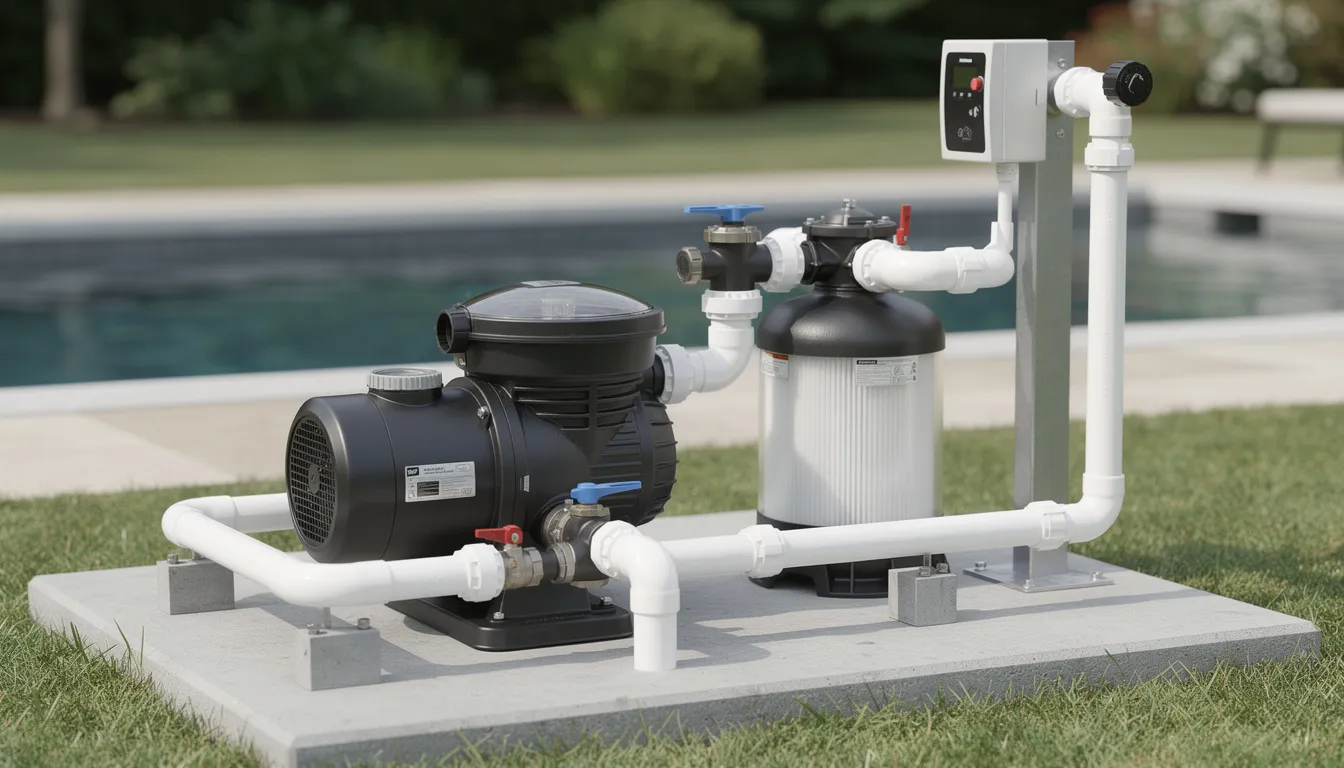
If you're going to make one upgrade to your pool equipment, start with the pump. The pool pump is the largest energy user in most pool systems—and it's also where you'll find the most dramatic efficiency gains.
The difference between running an old single speed pump and a modern energy efficient pool pump isn't incremental. It's transformational. We're talking about going from $80–$120 per month in electricity costs down to $15–$30 for the same filtration performance. That's not a typo.
Here's how the main pump types compare:
Single-speed pumps are the old standard, typically found in pools built before 2015. They run at one speed (usually 3,450 RPM) regardless of the task. You need gentle filtration? Full power. You need to run a pool cleaner? Same full power. These pumps are 30–70% efficient at best and pull 1,500–2,500 watts continuously. Most people running these pumps are spending extra money every month without realizing it.
Two-speed pumps offer a high and low setting, which is better than nothing. Running on low speed can save 20–50% compared to single-speed operation. But they lack the granular control that delivers maximum efficiency, and many are being phased out as standards tighten.
Variable-speed pumps (VS pumps) are the current gold standard. These use permanent magnet motors with programmable RPM settings, typically ranging from 600 to 3,450 RPM. They can run longer at lower speeds—which actually improves filtration while using a fraction of the power. A VS pump running at half speed uses only about one-eighth the energy (thanks to the affinity laws of fluid dynamics). Most variable speed pumps achieve 80–90% motor efficiency.
For a typical in-ground pool running 8–12 hours daily:
Single speed: $50–$120 per month in electricity during peak season
Variable speed: $10–$30 per month for equivalent or better filtration
The math is simple. If your electricity rate is $0.15 per kWh and you save 150 kWh monthly, that's $270 per year. At $0.25 per kWh, it's $450. Over the 10+ year lifetime of a quality VS pump, the energy savings alone can exceed $3,000–$6,000.
Many existing U.S. residential pools still have pre-2020 single speed pumps. If that describes your pool, you're sitting on one of the fastest-payback home efficiency upgrades available.
Choosing an Efficient Pool Pump
Buying an efficient pool pump isn't about grabbing the highest horsepower model on the shelf. In fact, oversized pumps waste energy and money. Here's how to choose the right pool pump for your situation:
Size based on hydraulics, not just HP. The right pump size depends on your pool's total dynamic head (TDH)—essentially, how hard the pump has to work against your plumbing, filter, and any elevation changes. It also depends on your pool volume in gallons and your target turnover time (how long it takes to circulate all the water through the filter). For most residential pools, 1–2 full turnovers per day is sufficient.
Look for ENERGY STAR certification. ENERGY STAR certified variable speed pumps must meet strict efficiency criteria and undergo independent testing. These models post their expected kWh per year at standardized conditions, making it easy to compare. The weighted energy factor (WEF) rating tells you how efficiently the pump moves water relative to energy consumed—higher is better.
Check compatibility before you buy. Verify that your new pump works with your existing plumbing (1.5" vs 2" pipes), your pool's filtering system (sand, cartridge, or DE), and any automation controllers you have. The good news: most modern VS pumps from major brands are designed as drop-in replacements with minimal re-plumbing required.
Consult a professional for installation. A qualified pool professional or licensed electrician can verify electrical requirements (115V vs 230V, proper breaker sizing) and program optimal speed schedules during installation. This upfront investment in proper setup maximizes your lifetime savings.
Realistic payback periods for a new pump range from 1–3 years in moderate-cost electricity markets. In areas where kWh prices exceed $0.25, payback can happen in under 12 months.
Operating Your Pump for Maximum Savings
Installing an energy efficient pumps is only half the equation. How you operate it determines your actual savings.
Aim for 1–2 full turnovers per day. Most pools need their entire volume filtered once or twice every 24 hours. With a variable speed pump, you can achieve this with 8–12 hours of low-speed operation instead of 6–8 hours at high speed. The result: better filtration with less energy use.
Limit high-speed runs. Reserve high RPM for tasks that genuinely require higher flow rate—running a pressure-side pool cleaner, operating water features, or supporting a heater that needs minimum flow. Keep these runs to 1–3 hours daily, with the rest of your schedule at lower speeds.
Use time-of-use scheduling. If your utility offers off-peak electricity rates (common in California, Arizona, and other markets), schedule the majority of pump running during discount hours. This can cut your effective cost per kWh by 30–50%.
Don't run the pump continuously. While it might seem like pump continuously running equals cleaner water, it's unnecessary for most pools. The built-in timers on modern VS pumps make it easy to set schedules. Running 24/7 at any speed wastes energy and shortens equipment life.
Maintain your system to maintain efficiency. Clean the pump basket weekly. Backwash or rinse filters according to manufacturer recommendations. Check for air leaks in suction lines. Every restriction you remove from the system lowers the pressure the pump works against, allowing it to run at lower speeds while still moving adequate water.
Efficient Pool Heating Options (Heaters, Heat Pumps, and Solar)
After the pump, heating is often the single largest pool energy cost—especially for pool owners in cooler climates or those who want to extend their swim season into spring and fall. Monthly heating costs of $100–$300 are common during shoulder seasons, and a poorly insulated pool can cost even more.
The three major heating technologies each have distinct strengths:
Gas heaters (natural gas or propane) heat water quickly, making them ideal for spa applications or pools that aren't used daily. Modern units are 82–95% efficient, with premium models using advanced heat exchangers to minimize flue losses. However, they rely on fossil fuel, so operating costs depend on volatile gas prices. A gas heater might cost $300–$600 per month to maintain 82°F in a cool climate.
Electric heat pumps don't generate heat—they move it from the surrounding air into your pool water using a refrigeration cycle. This makes them remarkably efficient. A quality heat pump delivers a COP (coefficient of performance) of 4–6, meaning you get 4–6 units of heat for every 1 unit of electricity consumed. In mild climates where air temperatures stay above 50°F, a heat pump can heat your pool for 70% less than a gas heater. They work best in regions like Florida, the Gulf Coast, and Southern California.
Solar thermal systems circulate pool water through roof-mounted or ground-mounted collectors that absorb heat from sunlight. The upfront cost is higher ($3,000–$6,000 installed), but operating energy cost is essentially zero. Output depends on sun exposure, roof orientation, and collector area—typically, you need collector square footage equal to 50–100% of your pool's surface area.
For pool owners in southern states, electric heat pumps and solar heaters typically offer the best lifetime cost. Colder-climate owners often benefit from combining solar collectors (for free daytime heating) with a gas heater (for quick heat-up on demand).
Using Covers and Solar Blankets to Slash Heating Losses
Here's a secret that costs almost nothing: a simple pool cover can save more energy than some equipment upgrades.
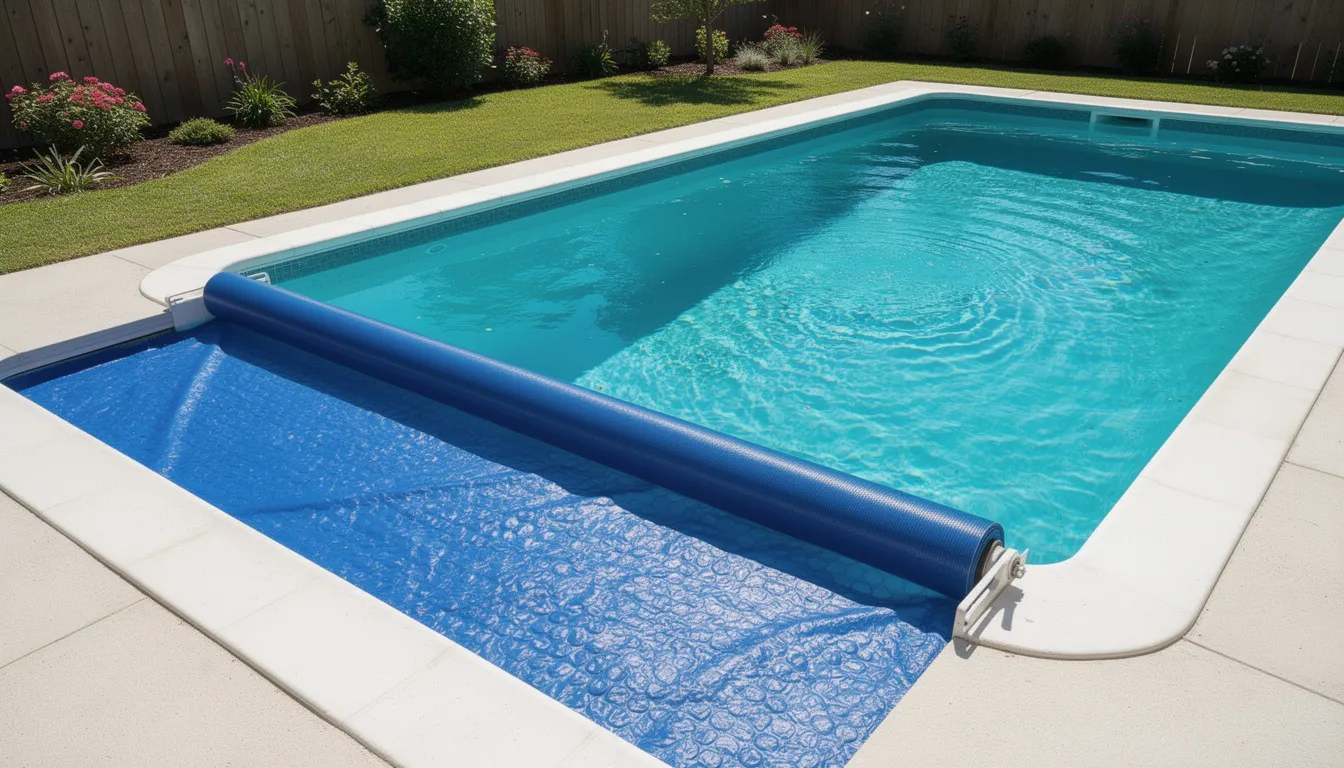
An inexpensive solar cover (bubble blanket) can cut nighttime heat loss by 50–70%. For pools with active heating, this dramatically reduces heater run time and fuel consumption. In many summer climates, consistent cover use eliminates the need for active heating entirely.
Evaporation accounts for 70% of heat loss in uncovered pools. Every gallon that evaporates carries away heat energy. Covers block this evaporation by 90–95%, keeping heat in the water where it belongs.
Different cover types serve different needs:
Bubble/solar blankets are the most affordable option ($50–$200), floating directly on the water surface
Liquid solar covers are chemical products that create an invisible surface layer—less effective than physical covers but convenient for daily swimmers
Automatic safety covers (motorized vinyl or polycarbonate slats) combine safety, heating efficiency, and convenience at premium prices ($8,000–$15,000 installed)
Practical guidance: Cover your pool whenever it's not in use, especially overnight and on windy days. Aim for at least 8–12 hours of coverage per day when heating is active. Even a manually-operated solar blanket, used consistently, can save $50–$150 monthly in heating costs during shoulder season.
Beyond heating savings, covers reduce water loss (saving on refill and chemical costs), block debris and UV (reducing sanitizer demand), and keep the pool cleaner—which means less work for your pump and filter.
Energy-Saving Filtration, Sanitization, and Cleaning Equipment
While the pump dominates your pool's power consumption, everything connected to it influences overall energy use. Filters, sanitizers, and cleaners all affect how long and how hard your pump must run.
Filter type matters. Your pool's filtering system creates resistance that the pump must overcome. Lower resistance means the pump can achieve the same flow rate at lower speeds—and lower speeds mean dramatic energy savings.
Cartridge filters typically operate at lower pressure than sand or DE filters, making them ideal partners for variable speed pumps. They require periodic cleaning but no backwashing (which wastes water and chemicals).
Sand filters are simple and durable but offer coarser filtration (down to 20–40 microns vs 10–20 for cartridge) and require regular backwashing that uses 150–300 gallons per cycle.
DE filters provide the finest filtration but need regular maintenance and DE powder replenishment.
For energy efficiency, keep any filter clean. A dirty filter increases head pressure, forcing the pump to work harder. Maintain your filter according to manufacturer specs and watch your pressure gauge—when it rises 8–10 PSI above clean baseline, it's time to clean.
Sanitizing options also affect energy use. Saltwater chlorine generators produce chlorine continuously but draw 200–500 watts during operation. UV and ozone systems reduce chemical demand but add modest electrical loads. These systems are worthwhile for water quality and convenience, but size them appropriately—oversized units waste power.
Cleaner selection can enable or eliminate an entire pump. Pressure-side cleaners (like Polaris) often require a dedicated booster pump drawing 700–1,500 watts. Robotic cleaners plug into a standard outlet and use their own low-voltage motor, typically consuming 100–200 watts. Running a robotic pool cleaner a few hours several times per week can replace hours of high-speed pump operation.
Regular maintenance habits indirectly save energy too. Skim leaves and collect debris quickly before they clog baskets. Trim nearby trees and shrubs to reduce organic load. Keep pump baskets and skimmer baskets clear. Every bit of reduced resistance translates to lower speeds and less energy usage.
Lighting and Automation: Small Upgrades, Noticeable Savings
Pool lighting consumes far less power than pumps or heaters, but outdated fixtures still waste money—and modern alternatives offer better light with great efficiency.
If your pool still has incandescent or halogen underwater lights from the 1990s or 2000s, you're using 300–500 watts per fixture for light you could get from a 40–60 watt LED. LED pool and spa lights use 70–90% less electricity and last 30,000–50,000 hours compared to 2,000–5,000 for incandescent bulbs. Many retrofit kits fit existing niches, making the upgrade straightforward.
Beyond the bulbs themselves, automation systems multiply savings by preventing waste. A programmable controller that manages pumps, heaters, and lights ensures equipment runs only when needed—not around the clock because someone forgot to flip a switch.
Modern pool automation offers:
Programmable schedules that match equipment operation to actual usage patterns
Remote control via smartphone apps for adjustments when you're away from home
Weather-responsive operation that reduces heating when ambient temperatures are warm
Time-of-use optimization that shifts power-hungry cycles to off-peak hours
Set up "energy-saving scenes" that activate with one tap: low pump RPM during off-peak hours, lights off at midnight, heater disabled when outdoor temps exceed 85°F. These automations prevent the common scenario where a homeowner runs equipment on conservative (energy-wasting) settings because adjusting them seems complicated.
Even basic timer upgrades help. If your current pump runs on an old mechanical timer with only on/off control, replacing it with a digital programmable timer ($30–$100) enables shorter, more targeted run cycles.
Costs, Rebates, and Payback for Energy-Efficient Pool Equipment
Energy efficient pool equipment requires upfront investment. But unlike many home improvements, pool efficiency upgrades typically pay for themselves through lower utility bills—often within a few years.
Here are realistic ballpark costs for 2026:
EquipmentTypical Installed CostAnnual Savings PotentialENERGY STAR variable-speed pump$900–$1,800$400–$800Electric heat pump$3,000–$6,000$300–$600 (vs gas)Solar pool heating system$3,500–$7,000$200–$500LED lighting retrofit (per fixture)$150–$400$20–$50Automatic pool cover$8,000–$15,000$200–$600Robotic cleaner (vs booster pump)$800–$1,500$100–$200Example scenario: Say you have a 1.5 HP single speed pump that currently costs ~$70/month to run during a 7-month swim season (~$490 annually). A new variable speed pump brings that down to ~$15/month (~$105 annually), saving roughly $385 per year. At an installed cost of $1,200, payback occurs in just over 3 years. After that, the savings are pure money in your pocket.
Rebates and incentives can significantly reduce your out-of-pocket costs. Many utilities offer $200–$400 rebates for ENERGY STAR certified pool pumps. Some states provide additional incentives for heat pumps or solar equipment. Federal tax credits (currently up to 30% for qualifying solar and high-efficiency equipment under IRA provisions) may apply to certain pool heating installations.
To find rebates in your area:
Search your electric utility's website for "pool pump rebate" or "energy efficiency programs"
Check the ENERGY STAR rebate finder by ZIP code
Ask your pool professional about current manufacturer promotions
When evaluating upgrades, think in terms of lifetime cost of ownership—not just the sticker price. A $1,500 variable speed pump that saves $500 per year and lasts 12 years delivers $6,000 in energy savings over its lifetime, plus potential rebates. Compare that to a $600 single speed pump that costs $600 per year to operate.
How to Estimate Your Own Savings
You don't need an engineering degree to estimate your potential savings. Here's a simple process:
Step 1: Find your electricity rate. Check your most recent utility bill for the cost per kWh. Most U.S. households pay $0.10–$0.35 per kWh depending on location and rate tier.
Step 2: Estimate your current pump energy use. Look at the nameplate on your existing pump for horsepower and voltage. A typical 1.5 HP single speed pump draws about 1,500–2,000 watts. Multiply watts by daily runtime hours, then by 30 for monthly kWh. Example: 1,800 watts × 8 hours × 30 days = 432 kWh/month.
Step 3: Compare to ENERGY STAR specifications. ENERGY STAR certified pumps list expected annual kWh at standardized test conditions. A typical VS pump might show 500–1,500 kWh/year for conditions similar to your pool. Divide by 12 for monthly comparison.
Step 4: Calculate the difference. If your current pump uses 400 kWh/month and a new VS pump would use 100 kWh/month, you're saving 300 kWh monthly. Multiply by your rate and months of use for annual dollar savings.
Most upgrades from single speed to variable speed save 1,000–3,000 kWh per year, depending on pool size, climate, and run schedule. At average national rates, that's $150–$450 annually—and considerably more in high-cost markets.
Several utilities and organizations offer online calculators that automate this process using your ZIP code and local rate data. The ENERGY STAR pool pump savings calculator is a good starting point.

Putting It All Together: A Practical 2026 Upgrade Plan
You've made it through the details. Now let's turn knowledge into action.
The biggest, fastest wins for pool energy efficiency come from three areas: upgrading to an ENERGY STAR certified variable speed pump, optimizing pump run times and schedules for your actual needs, and improving heating efficiency through covers and—where needed—a heat pump or solar system.
Here's a prioritized action plan:
Step 1: Audit your current equipment. Walk your equipment pad and note the age, type, and nameplate specs of your pump, heater, and filter. Check your electricity bill for seasonal spikes that indicate pool-related usage. This baseline helps you prioritize.
Step 2: Replace any older single speed pump first. This is almost always the highest-return upgrade. If your pump is more than 8–10 years old or lacks variable speed capability, put replacement at the top of your list.
Step 3: Add or consistently use a pool cover. If you don't have one, buy an inexpensive solar blanket. If you have one gathering dust in the garage, commit to using it. Covers cost little and save much.
Step 4: Address heater efficiency. If you heat your pool regularly and your heater is aging, evaluate whether a heat pump or solar system makes sense for your climate. If you rarely heat, confirm whether heating is actually necessary before investing.
Step 5: Consider ancillary upgrades. LED lights, automation controllers, and robotic cleaners offer incremental savings and convenience. These are lower priority than pump and heating improvements but worth considering as part of a comprehensive upgrade.
Step 6: Check rebates and schedule installation. Research available utility rebates before purchasing. Schedule upgrades in early spring to capture a full season of savings and avoid the summer installation backlog when contractors are swamped.
The equipment choices you make in 2026 will likely shape your pool's energy use and comfort for the next 10–15 years. Variable speed technology is mature, prices are competitive, and rebates are widely available. There's no better time to make the switch.
Start with an honest assessment of your current equipment. If that pump humming in your equipment pad is more than a decade old, it's probably costing you more than you realize—and the solution is simpler than you might think.